

If You're Low on Refrigerant, You've Got a Leak.
Refrigerant doesn't get used up — it's sealed in a closed loop. If you're low, it's escaping somewhere. The fix isn't to "top it off." The fix is to find the leak, repair it, and recharge to spec. EPA-certified work only.
Three Tiers of Leak Severity
The size of the leak tells us how urgent the call is. Match your symptoms to the closest tier below.
Tier 1 — Shut It Off Now
Active or major leak. Running the system pumps the remaining refrigerant out and lets the compressor cook itself. The longer it runs, the larger the eventual repair.
Tier 2 — Schedule Soon
Moderate slow leak. The system still cools but works harder, runs longer, and costs more to operate. The compressor isn't in critical territory yet — but it's heading there.
Tier 3 — Catch at Tune-Up
Trace leak. System is still operating to spec but slowly losing pressure. A spring tune-up's pressure test catches these early so we fix it on a normal weekday, not an emergency call in July.
What's Actually Happening Inside Your AC
Refrigerant is widely misunderstood. The longer-form sections below decode the technical and legal realities homeowners run into.
The Closed Loop
Your AC's refrigerant lives in a fully sealed loop: compressor → outdoor coil → line set → indoor evaporator coil → back to the compressor. Under normal operation, refrigerant cycles through this loop hundreds of times a day — without ever leaving the system.
Why That Matters
Unlike gas in your car or oil in your engine, refrigerant doesn't get consumed. No matter how many seasons your AC runs, the original refrigerant charge should still be there at the end. If a tech tells you it "needs a top-off," what they're saying is: "there's a leak I haven't found."
What Happens When Charge Drops
- Pressure drops — coil temperature falls below freezing, ice forms
- Heat-transfer efficiency collapses — cooling output weakens
- Compressor strains to maintain cycle — motor windings overheat
- System runs longer to hit setpoint — energy bills spike
The Math Doesn't Work for the Customer
Refrigerant isn't cheap. R-410A runs about $80-150 per pound at wholesale, and your system typically holds 5-15 pounds. If a tech recharges your system without repairing the leak, you're paying hundreds of dollars to replace refrigerant that will leak right back out — sometimes within weeks.
The Legal Issue
EPA Section 608 requires technicians to repair leaks larger than a defined threshold before recharging. "Top off and go" recharging on a known leak violates federal regulation. Reputable contractors don't do this. Walk away from anyone who suggests it.
The Right Process
- Confirm low charge with manifold gauges (not guessing)
- Find the leak with electronic detector or UV dye
- Repair the leak (flare fitting, valve, weld, or coil replacement)
- Evacuate the entire system with a vacuum pump
- Recharge to the exact factory spec using a scale
- Verify with pressure/temperature readings under load
Flare Fittings
The mechanical connections at the outdoor unit. Over time, vibration loosens them. Most common leak point. Often fixable by re-flaring and re-torquing.
Schrader Valves
The service valves where techs connect their gauges. Cores wear out and start weeping slowly. Often the leak from a recent service call.
Evaporator Coil
The indoor coil corrodes from formaldehyde and formic acid in household air (yes, really). Older Mount Clemens, Sterling Heights, and Royal Oak homes with 12+ year-old systems often need coil replacement, not just repair.
Line Set Joints
The brazed joints on the copper line set between indoor and outdoor units. Vibration and thermal cycling eventually crack them. Usually a small braze repair.
Condenser Coil Damage
External damage from cottonwood debris being power-washed too hard, or the fan blade nicking a tube. Less common but real.
R-22 (Phased Out)
If your AC is from before 2010, it likely runs R-22. Production ended December 31, 2020 under the Montreal Protocol. Remaining stock is reclaimed-only and extremely expensive — often $150+ per pound. A leak repair on R-22 frequently costs more than the system is worth. This is usually the moment to replace.
R-410A (Current Standard)
Most AC systems installed between 2010 and 2024 use R-410A. Still widely available, still being produced, repair-economical. Most leak fixes on R-410A systems are straightforward and cost-effective.
R-454B (The New Standard)
As of January 2025, new residential AC manufacturing transitioned to R-454B (and similar low-GWP refrigerants) under the AIM Act. If your system was installed in 2025 or later, you're on R-454B. Same physics, lower environmental impact.
Why It Matters for Your Repair
- R-22 leak repair: often uneconomical — replacement is the smart move
- R-410A leak repair: still very economical
- R-454B leak repair: equipment is newest, parts are widely stocked
What the Law Requires
EPA Section 608 of the Clean Air Act regulates the handling, recovery, recycling, and disposal of refrigerants. Technicians must be certified at the appropriate level (Type I, II, III, or Universal) for the equipment they service. Recovered refrigerant must be reclaimed through certified channels — never vented to atmosphere.
Why It Matters to You
- Hiring a non-certified tech is a federal violation
- Improper handling damages the ozone layer and creates GHG emissions
- Improper recharging (wrong type, wrong amount) damages your equipment
- Reputable contractors carry certification cards on every truck
Our Certifications
Every NEXT tech holds an active EPA Section 608 Universal certification. We can show you the card on-site. We recover refrigerant with proper recovery units and send it through certified reclamation channels — never vented.
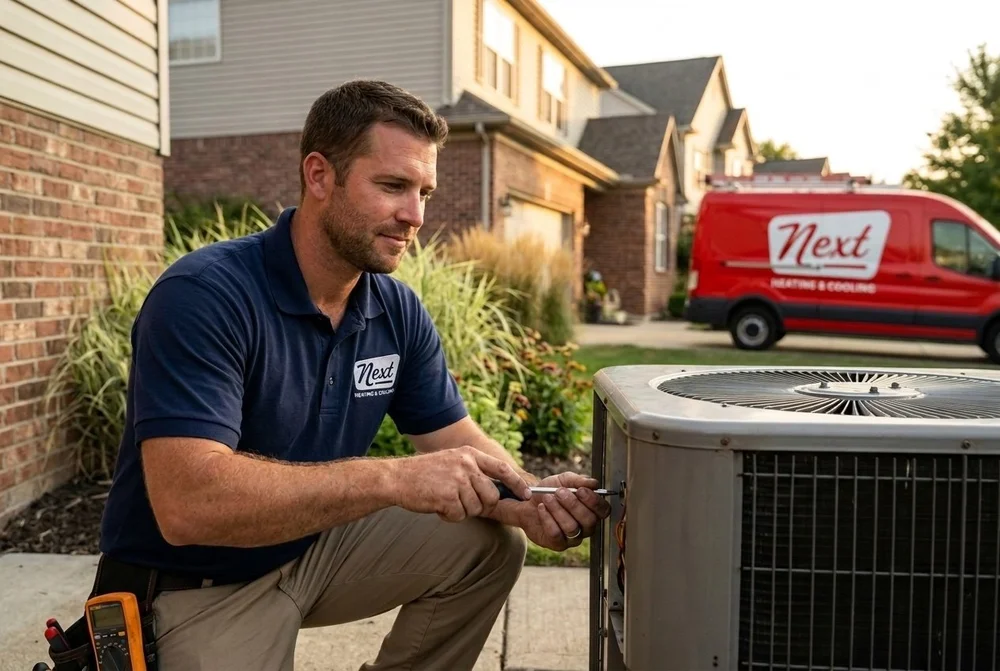
Refrigerant Leaks Are Easier to Fix Small
A slow leak caught in spring becomes a 20-minute Schrader-valve repair. The same leak ignored until July becomes a frozen-coil emergency with compressor damage. Our $5/mo NEXT Care Plan's spring AC tune-up includes a refrigerant pressure test — we catch the slow leaks before they catch you.
Signs of a Refrigerant Leak Decoded
Match the symptom to the urgency level. Bookmark this for next summer.
Symptom → Likely Cause → Action
What you see/hear/smell on the unit, what's actually happening, and what to do.
We Quote Refrigerant Repairs On-Site
A Schrader valve fix and a coil replacement both start with "low refrigerant" on the gauges — but the fixes are wildly different. That's why we come out, measure, find the leak, and quote you face-to-face. No phone-quoted bait-and-switches. No top-off-and-run jobs.
EPA-Certified Refrigerant Repair Across Southeast Michigan
Same-day leak detection and repair from a local crew with full Section 608 certifications on every truck.
Macomb County
Our home base. Mount Clemens, Sterling Heights, Warren, Clinton Township, Roseville, Chesterfield, Shelby Township, Macomb, St. Clair Shores, Eastpointe.
Average response: same-day
Oakland County
Full coverage west to Pontiac. Royal Oak, Birmingham, Bloomfield Hills, Rochester Hills, Troy, Madison Heights, Ferndale, Lake Orion, Auburn Hills, Beverly Hills, Southfield, South Lyon.
Average response: same-day to next-day
St. Clair County
North Macomb to the lake. Port Huron, Marysville, St. Clair, Algonac, Marine City, Yale, Capac, and the surrounding river communities.
Average response: next-day
Not sure if we cover your area? Just call (844) 279-HVAC — if we don't service your zip code, we'll point you to someone who does.
Low Refrigerant Often Shows Up Other Ways First
Click through to diagnose the related symptoms that frequently pair with a leak.
More HVAC Tips for Michigan Homeowners
Real advice from our technicians — what to watch for, when to call, and how to keep your bills in check.
Low Refrigerant Questions
Find the Leak. Fix It Right.
EPA-certified leak detection, real repair (not just a top-off), and proper recharge to spec. Same-day service across Macomb, Oakland, and St. Clair Counties.

Next Heating & Cooling
Licensed AC repair, installation, and maintenance across Macomb, Oakland, and St. Clair Counties. Same-day service plus our $5/mo NEXT Care Plan.